Why I built Claudictive: Claude Code in my game, without babysitting it
Written by Odi with Claude, from the Claudictive git history. Every claim is checked against its source before it is published. How we write
Claudictive is a free Windows overlay that lets you code with an AI agent while you play. Your own Claude Code session keeps running, and when it asks a question or wants an approval, that shows up in your game and you answer it there, without alt-tabbing out. I built it because I did not want to keep babysitting my agent.
This is the first post on this blog, so it is about the why, not the how. Claudictive is my own independent project: Anthropic and Overwolf did not make it and do not endorse it.
Why does Claudictive exist?
It started with Total War: Shogun 2. As I told Claude when it interviewed me for this blog:
I wanted to play Shogun 2, specifically. I had no second screen, and clicking off screen made the game lose focus and minimize.
At the time I was building a small feedback tool for vibe coders, in long Claude Code sessions.
I wanted to just stop so I could play, especially when these sessions take a lot of time.
I wanted to step away and play, but the sessions kept needing me.
What goes wrong when you leave Claude Code working and go play?
It stops and waits for you. Before Claudictive existed, I left a session working and played a League of Legends match.
After the game I saw it had barely thought, and had asked something basic that was completely missed.
I mainly got angry. I wanted things to work for me, and now I needed to keep babysitting my agent. That's the premise that led me to build Claudictive in the first place.
I had also tried letting long work run on its own:
At the beginning I tried some long-running work strategies using get-shit-done, but it didn't work. Even in Yolo mode, permissions, asks and questions were a constant issue, several every session. That's where the idea came up, last year. I was also sure I'd find a generic solution, but none existed.
So I started building one.
What does "full control" mean in Claudictive?
The advice I found about babysitting an AI agent is about cutting down the prompts. Claudictive does not take the questions away; it brings them to where you are. My definition:
Claude Code is in your game, fully. That's what full control is.
In what ships today, that means:
- It is the session you already have open. What you send in game runs there, and your terminal shows it live.
- You answer Claude's questions in game. The terminal still works too, and whichever you answer first wins.
- You allow or deny a command or file edit from a small pill with a hotkey, without opening the chat.
- When you close the game, Claudictive hands the session back to your terminal.
There is more on how this looks on the Claude Code in your game page.
What should coding with an AI agent while you play feel like?
Here is what I want from it:
Out of sight while you're focused on the game, and it appears when you're waiting and Claude needs you.
Overwolf draws the overlay inside the game, so it works in fullscreen, in games like World of Warcraft, Valorant or Dota 2. Most of the time it is a small pill you can click through. When Claude needs you, it tells you, you answer, and you go back to the match.
Who is Claudictive for?
Claudictive is for me, honestly, and for anyone else who's experiencing things like I do: people who want to experience the game but still make sure their Claude is working efficiently.
Why it matters to me, as a vibe coder:
I just want to dev as fast as I can as a vibe coder, and I want to make sure everything is going smoothly.
What success looks like to me:
When people open it and answer questions from in game without alt-tabbing.
What principles is Claudictive built on?
These are the four principles I build by today:
- It is your own Claude Code session. Claudictive attaches to the Claude Code you already use, with your own sign-in and your own plan or API key. It has no account or connection to Claude of its own.
- Nothing changes without your OK. Before Claudictive adds anything to your Claude Code setup, a screen lists exactly what, and nothing is written until you choose Allow. The questions and approvals your session stops for still come to you. You can reverse most of it again from the hub.
- Your data stays on your PC. Your conversations, session history and match summaries are kept on your machine, and your messages reach Claude through your own Claude Code, as always. Claudictive sends nothing to me unless you opt in to analytics or crash reports, or send a bug report. Ads are served by Overwolf. Details are in the privacy policy.
- It is free. Claudictive is free today and ad-supported. Your Claude usage stays on your own plan or API key.
Privacy is a habit more than a feature. When I picked how this website handles phone visitors, my rule was:
I choose the method that would reduce the privacy risks as far as possible. And I wanted something quick, relatively.
What was it like building it with Claude Code?
I have built Claudictive with Claude Code for about eight months. I decide what to build, test builds in game and approve every release. Claude writes much of the code, investigates bugs and proposes options.
The moment that stands out:
Eating my own dog food on this was amazing. Shipping code for Claudictive from the overlay for the first time was phenomenal. It took so long to stabilize that I never thought I could do it.
A tool for using Claude Code in game, shipped from in game. If you want to try it, it is a free download from the Claudictive home page.
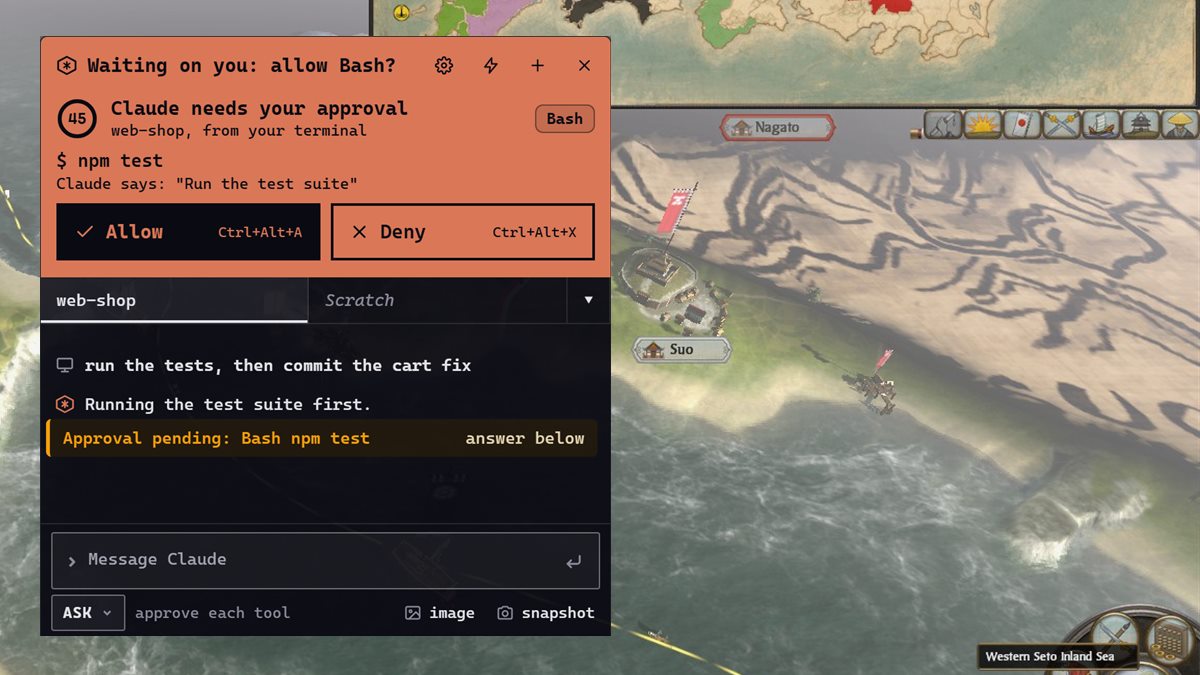
Illustration: the Claudictive overlay over my own Total War: Shogun 2 screenshot. Not a live capture. A real capture from an Oda campaign is on the Claude Code in Shogun 2 page.